
One platform for every manual operation on the shop floor.
Picking, assembly, tightening, wiring, packaging and inspection run on the same Arkite software core. Each workstation receives the right job from MES, guides the operator step by step and feeds structured data back to one central server.
Last updated
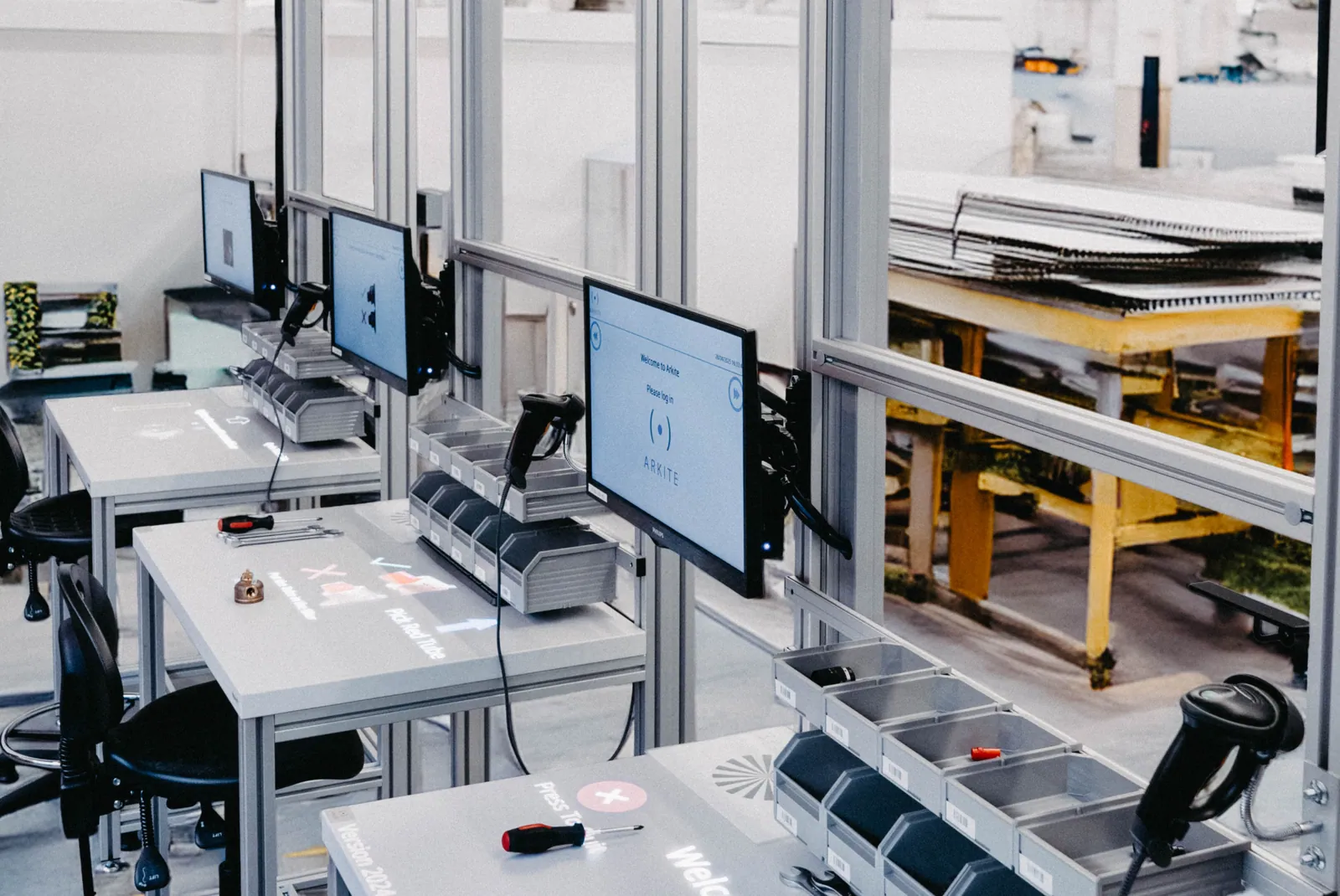
The same execution layer, wherever people do the work
ERP decides what to build. MES decides when to build. Arkite tells operators how to build, in every area where work is still done by hand.
Process engineers configure each operation in the same no-code workflow engine. Projects are stored on the Arkite server, deployed to the right workstations and maintained centrally. A picking station, a tightening station and an inspection station differ in tasks and sensors, not in software.
Applications by operation
Select an operation to see how Arkite guides, validates and records it, and which maturity level applies.
Picking and kitting
Pick-by-projection or DMX lights show the right bin. The 3D sensor validates every pick and logs the quantity.
GUIDE · VALIDATESub-assembly
Structured guidance for modules and sub-assemblies that feed the main line, with variant logic and traceability per unit.
GUIDE · VALIDATE · VISIONAssembly
Step-by-step projected instructions for complex, high-mix assembly, validated in real time before the next step starts.
GUIDE · VALIDATETightening
Smart tool connectivity that controls sequence, location and torque, and records torque values per assembled unit.
GUIDE · VALIDATE · VISIONCabling and wiring
Projected routing and connection guidance for cables, harnesses and terminals, including 1:1 drawings on the workbench.
GUIDE · VALIDATEPackaging
Dynamic projections driven by external stacking algorithms, variant-specific content checks and validated packing steps.
VISIONQuality inspection
In-process product inspection with Arkite VISION: presence, orientation, position and quality checks during assembly.
Choose the validation depth each operation requires
One software core, three levels. Mixed-license environments are supported, so each workstation runs the level its task requires.
| GUIDE | VALIDATE | VISION | |
|---|---|---|---|
| Projected and on-screen work instructions, variants, experience levels | |||
| Integration with MES, ERP, PLC, smart tools and scanners | |||
| Automatic validation of picks, placements and tool use (3D sensor) | – | ||
| Smart tool enabled only at the correct location | – | ||
| In-process product inspection: small parts, orientation, position | – | – |
What do you want to improve?
Start from the operational problem. Each page explains which capabilities address it and which data proves the effect.
Error reduction
Prevent wrong or missing parts, skipped steps and sequence errors before they become defects.
Scrap and rework
Find issues during assembly instead of at end-of-line test or at the customer.
Operator training
Replace paper manuals and side-by-side training with guidance at the workstation.
Product variants
Run high-mix production with the correct procedure for every variant, selected by MES or scan.
Standardized work
Make every operator follow the same validated procedure, on every shift and at every site.
Traceability
Record every step, validation and torque value against an order and serial number.
Production efficiency
Use cycle times and step durations to find bottlenecks and balance the line.
Every manual operation becomes a documented, validated and data-generating process, managed from one central server.
Build the business case on your own production data.
The business case for Arkite is built on your own production data. A pilot workstation is the most reliable way to validate these assumptions in your own environment before a wider rollout.
- Current error, scrap and rework rates, and the cost per defect
- Labor cost and cycle times
- Number of new operators trained per year and time to full competency
- Number of product variants and frequency of changes
- Cost of quality escapes and customer complaints
See your operation on an Arkite workstation
A demonstration in the context of your own process is the most direct way to scope a pilot workstation.