
Applied production scenarios.
How manufacturers apply Arkite to specific manual operations: the production problem, what was configured at the workstation and which systems were connected. Customer names are withheld.
Last updated
One platform, configured per operation.
Each scenario below runs on the same Arkite software core. What differs is the configuration: the license tier per workstation, the number of sensors and projectors, the detections taught and the systems connected, from barcode scanners and smart tools to PLCs, MES, ERP and databases.
The recurring pattern is the same. Errors that were found at the end of the line, or by the customer, are prevented at the step where they occur, and every validated action is logged.
Final and main assembly.
Safety-critical component placement with line interlock
Automotive OEM. Dozens of small safety components placed across two workstations. Arkite guides picking and placement, and a PLC interlock holds the line until every part is validated in position.
ElectronicsMulti-variant product assembly with ERP orchestration
Electronics manufacturer. Many variants built at one workstation. ERP integration provides the build, operator badge approval controls who may build it, and barcode scans check part compatibility.
AutomotiveVariant-driven assembly started by the PLC
Automotive supplier. At start-up the PLC communicates the product type. Arkite guides every operation, with dedicated guidance for a critical priming sequence where both order and location matter.
High-techHigh-value modules with look-alike components
High-tech supplier to the semiconductor market. Small, similar components with a strict sequence per type replace color-coded paper manuals with guided, validated picking and placement.
Sub-assemblies and module builds.
Compressor sub-assembly with serial traceability
Industrial equipment manufacturer. Guided picking and assembly, serial numbers scanned per unit, the power tool program selected per task and product snapshots linked to the serial number.
High-techMultiple sub-assemblies with flexible batch sizes
Precision engineering company. A complex product with many sub-assemblies, guided and verified at the workstation, with dynamic batch sizes instead of fixed runs.
MachineryMulti-operator stations with check-in
Industrial equipment manufacturer. Several operators work on different products at two stations. Operator check-in provides traceability across stations, and four tools are managed through the tool controller.
Controlled tightening sequences.
Critical screw sequence with multiple torque programs
Agricultural machinery manufacturer. Arkite guides each screw in the required order and disables the tool outside the sequence, while the tool controller applies the correct torque program per location.
MachineryStaged tightening with rising torque values
Agricultural machinery manufacturer. The same sequence must be completed three times at increasing torque. Guidance and tool communication prevent operators from skipping the lower stages.
AerospaceSpace-grade PCB modules with full torque records
Aerospace supplier. Low-volume, complex modules with many fasteners and several smart tools. Every pick, scan, torque result and snapshot is written to the customer's database.
Cable routing and connection.
I/O module wiring with color-coded cables
Equipment manufacturer. Many unique cables and many small connection points. Arkite projects the pick and the exact connection location for each cable, which also simplifies onboarding of new operators.
MachineryVariant-specific cable routing on large assemblies
Agricultural machinery manufacturer. Routing differs strongly between variants, some built rarely. A barcode scan identifies the variant and the routing is projected on the workstation and shown on screen.
Kitting with light guidance and 3D validation.
In logistics and kitting, the challenge is rarely the individual pick. It is the number of formats, variants and bins an operator must handle without error.
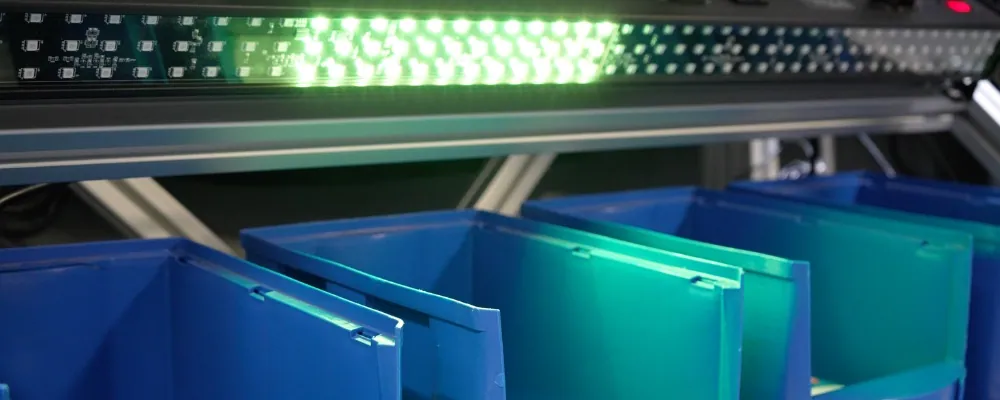
An automotive aftermarket logistics operation uses Arkite at pick and label stations to kit components into handling units across a large range of box formats. Light-guided pick and place follows a packaging algorithm for the fill pattern, and every action is logged for tracing and performance analysis.
A motorsport and road-car parts supplier guides two different picking and assembly processes with a single 3D sensor, adapting quickly to frequent design changes.
- Projection or DMX pick-to-light per bin
- 3D validation of every pick
- Quantities shown in the instruction and logged
- One sensor can cover more than one process
Packing and end-of-line operations.
High-variant packing table
Towing systems manufacturer. Product combinations run into the thousands. A start-up check defines the content of the workstation per variant, and picking is guided with confirmation, reducing faulty deliveries.
AutomotivePress loading guided by drawing coordinates
Automotive supplier. Operators place supports on a cart at positions taken from a technical drawing. Arkite reads X and Y coordinates from a database, projects each position and verifies placement.
In-process quality and traceability.
Conveyor-line PCB assembly with MES integration
Electronics manufacturing services provider. SMD components placed on multi-board pallets. Arkite starts guidance when the pallet arrives, validates each placement, scans components to the MES and releases the conveyor stop when done.
MedicalCleanroom assembly integrated in the production line
Healthcare manufacturer. Arkite is connected to the line through PLC communication and guides and verifies operator actions on a complex process where incorrect part placement must be prevented.
AutomotiveProcess checklists replaced by validated steps
Automotive coating and assembly supplier. A customer-required paper checklist is replaced by validated picking, assembly and tooling steps, with confirmation sent to the internal network.
Every scenario on this page runs on the same software core, configured by process engineers without code.
Have a comparable operation?
Show us the process. We map it to a pilot workstation: tier, layout, detections and integrations.