
Downloadable platform documentation.
Background reading for engineering, operations and quality teams: how projected AR and validated work instructions work in manual production, and how the Arkite platform is applied on real workstations.
Last updated
Guides for manual operations.
Each e-book is available on request. Leave your details and the Arkite team sends the document.
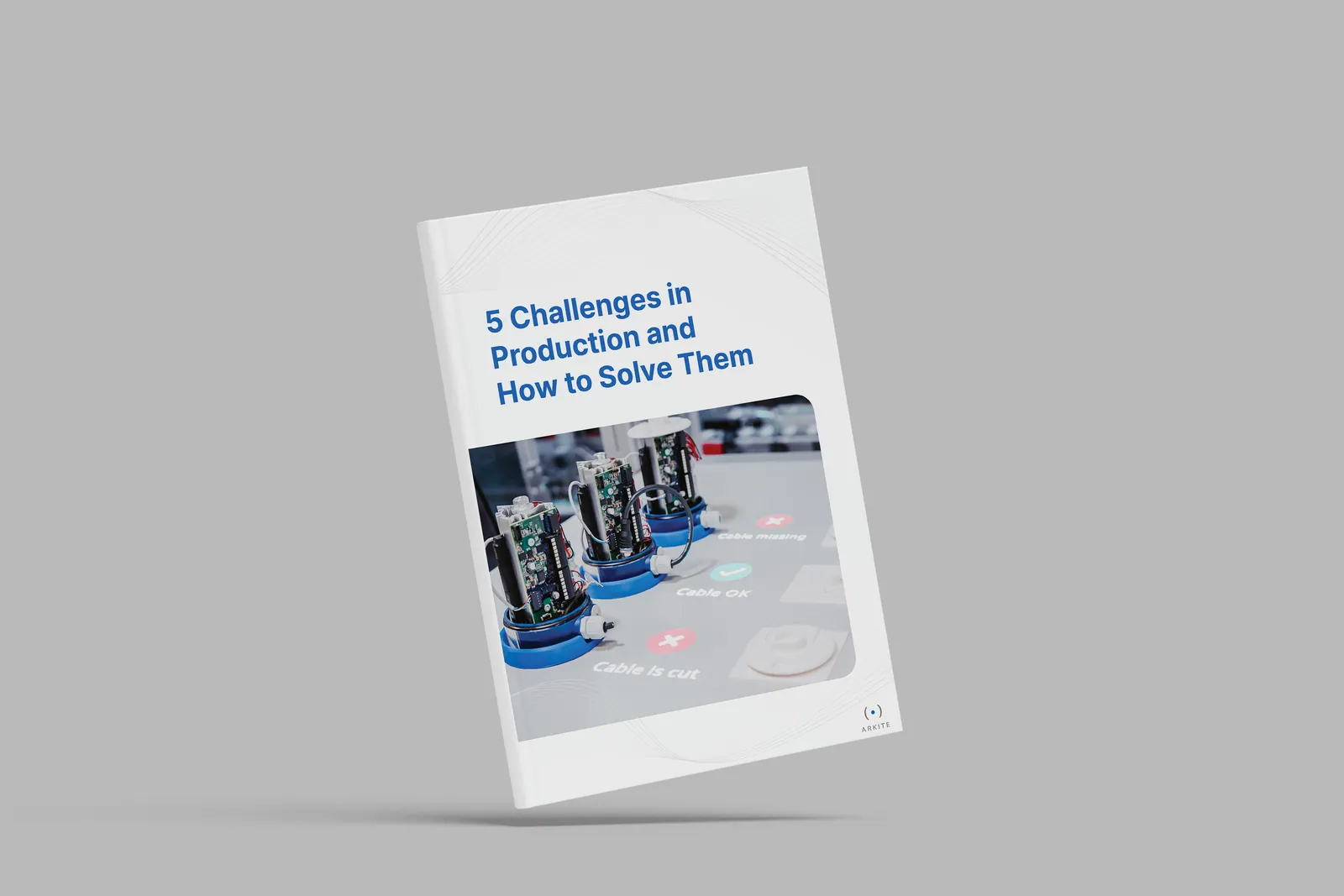
5 Challenges in Production and How to Solve Them
Five pressures on manual production: finding and keeping skilled operators, absorbing demand peaks, deciding how far to automate, competing from high-cost regions and the hidden cost of low prices. For each, the role of a flexible, well-guided workforce and digital work instructions.
IntroductionProjected Augmented Reality in Manufacturing for Beginners
A primer for teams new to projected AR: what it is, why it improves quality through real-time validation, how it connects to MES and ERP, how GUIDE, VALIDATE and VISION differ, and what to consider when setting up a first workstation.
EvaluationIs Projected AR the Answer to Your Manufacturing Challenges?
The practical case for projecting instructions instead of only showing them on a screen: clarity on any surface, instructions in the operator's field of view, central updates and safety alerts, and how to judge whether projected AR fits your operation.
Work instructionsProjected Work Instructions
How projected, validated work instructions change the assembly line when they are connected to the wider software landscape: ERP production orders and materials, variant-specific instructions and the removal of paper checklists and redundant steps.
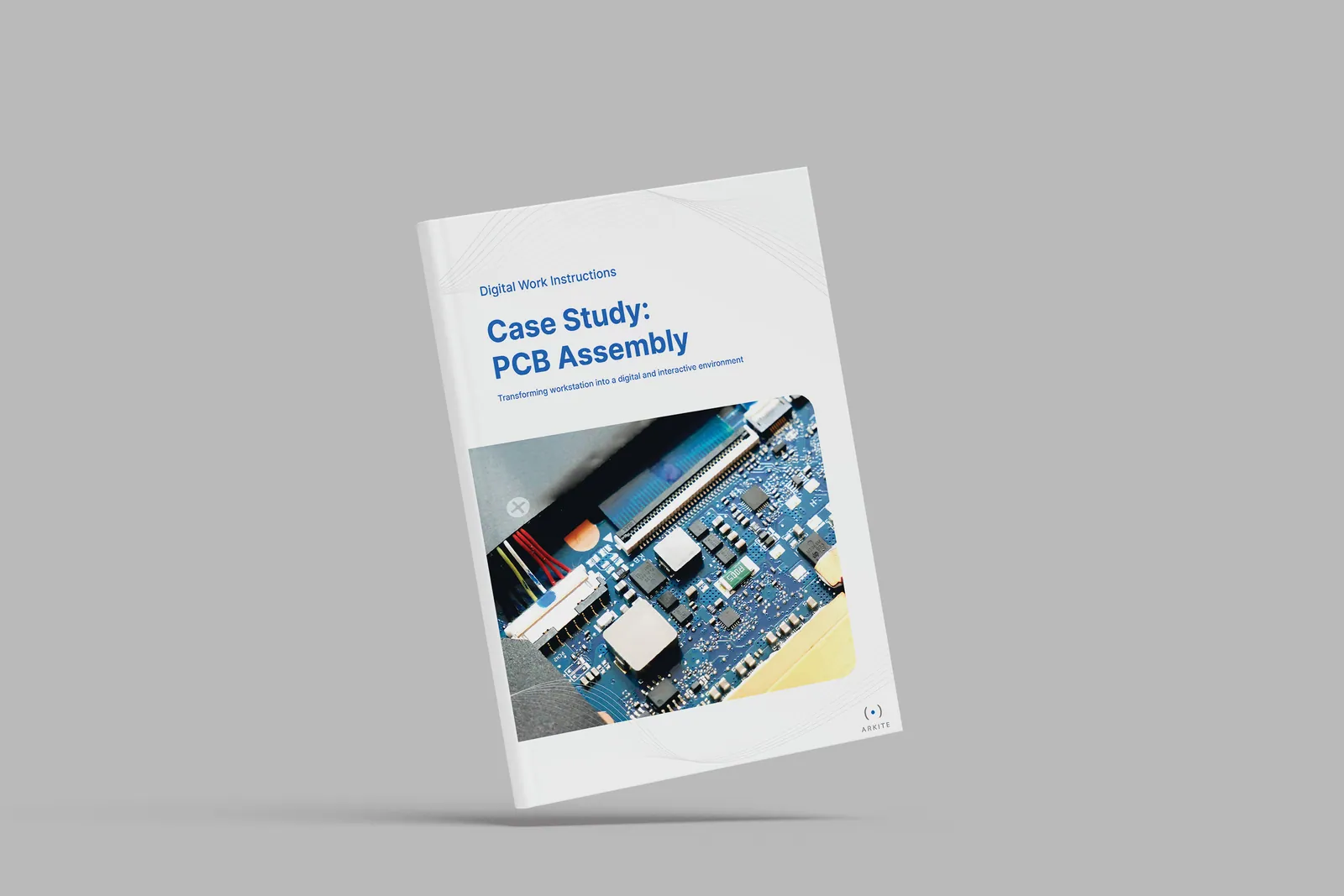
ElectronicsCase Study: PCB Assembly
An electronics manufacturing services provider standardizes SMD component placement on a conveyor line. The study describes the pilot workstation, MES and barcode integration, conveyor stop control, step validation by the 3D sensor and experience-level guidance.
PCB assembly on a conveyor line.
Operators placed SMD components on pallets of four circuit boards in no fixed order, which led to dropped, misplaced and forgotten components.
The case study follows the pilot: workstation preparation remotely from existing station instruction cards, installation above the conveyor, integration with the barcode-driven MES and the conveyor's stopping system, and step-by-step guidance validated by the Arkite 3D sensor.
- Guidance starts automatically when a pallet arrives
- Each placement validated before the next step
- Components scanned and reported to the MES
- Conveyor released only when the assembly is complete
Technical reference.
Platform FAQ
Fifty answers on tiers, workstation hardware, integration, deployment, data and licensing, based on software version 2026.2.
Integration overview
Supported systems and protocols: MES, ERP, PLC, OPC UA, MQTT, Modbus, Open Protocol, databases and BI.
Technical documentation for projects
Server and workstation requirements, mounting guidance and API documentation are shared during project scoping.
Need a specific document?
Ask for an e-book or the technical documentation for your project, or see the platform live.