
Inspection after the fact
Quality checks at the end of the line detect defects once value has already been added on top of them.
A missing washer costs seconds to fix during assembly and far more once the product is closed, tested or shipped. Arkite moves quality control into the process itself.
Last updated
In manual assembly, most scrap and rework starts with one small deviation: a component left out, a part mounted in the wrong orientation, a connector not fully seated. When the error is only detected at end-of-line inspection, the product must be disassembled, corrected and retested, or scrapped.
The cost drivers are familiar to every operations manager: rework labor, scrapped material, disassembly time, delayed orders, quality investigations and, in the worst case, customer complaints. The later a defect is found, the more each of these grows.
Quality checks at the end of the line detect defects once value has already been added on top of them.
Washers, clips and screws are easy to miss and hard to see once the next component covers them.
Repetitive tasks and frequent variant changes both increase the chance of a forgotten or incorrect step.
Arkite VALIDATE uses a 3D sensor to confirm that every pick and assembly action is executed correctly and in the right sequence. An incorrect action is flagged immediately, before the next step starts.
Arkite VISION adds a high-definition Vision sensor that inspects the product during assembly. It checks presence of small components from 0.5 cm, orientation, position within a configurable tolerance and quality criteria with multiple result classes, each with its own rework path.
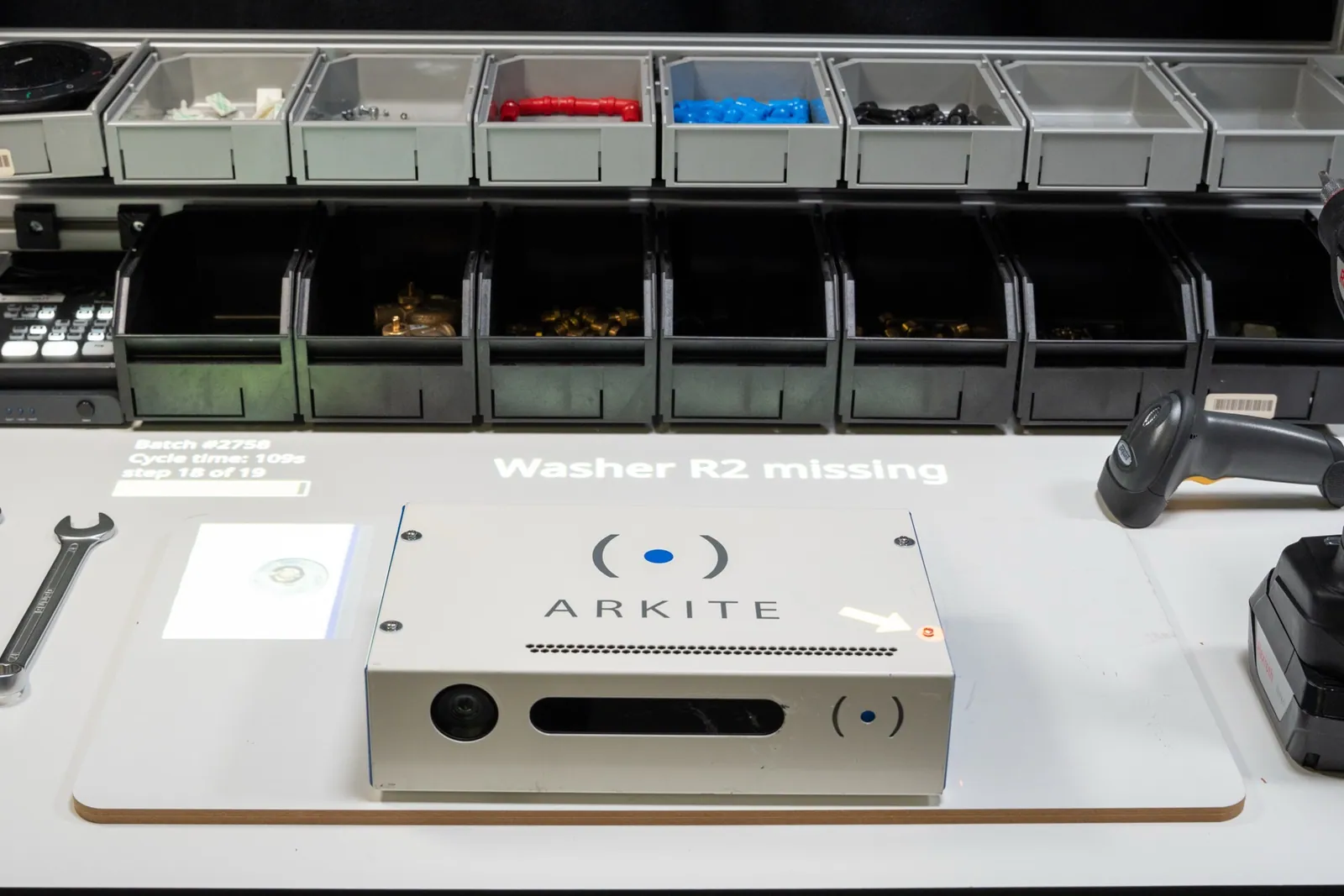
The 3D sensor checks that the right part was picked and placed at the right location.
With VISION, the product is checked for presence, orientation and position before the step is closed.
If a deviation is found, the workflow follows a defined rework path with projected instructions.
Every error and validation result is logged against the unit, the step and the workstation.
Arkite validates operator actions in real time and, with VISION, inspects the product during assembly. Issues are found at the step where they occur, when correction is fastest and cheapest.
The Arkite Vision sensor detects the presence of small components from 0.5 cm, such as washers, clips and screws, and also checks orientation and position.
Yes. Quality checks can have multiple result classes, and each class can trigger its own rework path with step-by-step instructions.
The business case is built on your own data: current scrap and rework rates, cost per defect, labor cost and cycle times. A pilot workstation validates these assumptions in your environment.
The business case for Arkite is built on your own production data. A pilot workstation is the most reliable way to validate these assumptions in your own environment before a wider rollout.
Bring your current rework and scrap rates. We help you scope a pilot that measures the effect on your own line.
Arkite
Operator guidance platform
Welcome to Arkite.
Looking to guide, validate and inspect manual work? Choose where you would like to start.
Prefer email? info@arkite.comPrivacy
Your privacy choices
We use analytics to understand how the website is used and, with your permission, to measure the results of our campaigns on LinkedIn and Google. Measurement runs through our own server; no tracking scripts from other companies are loaded in your browser. See our privacy notice.